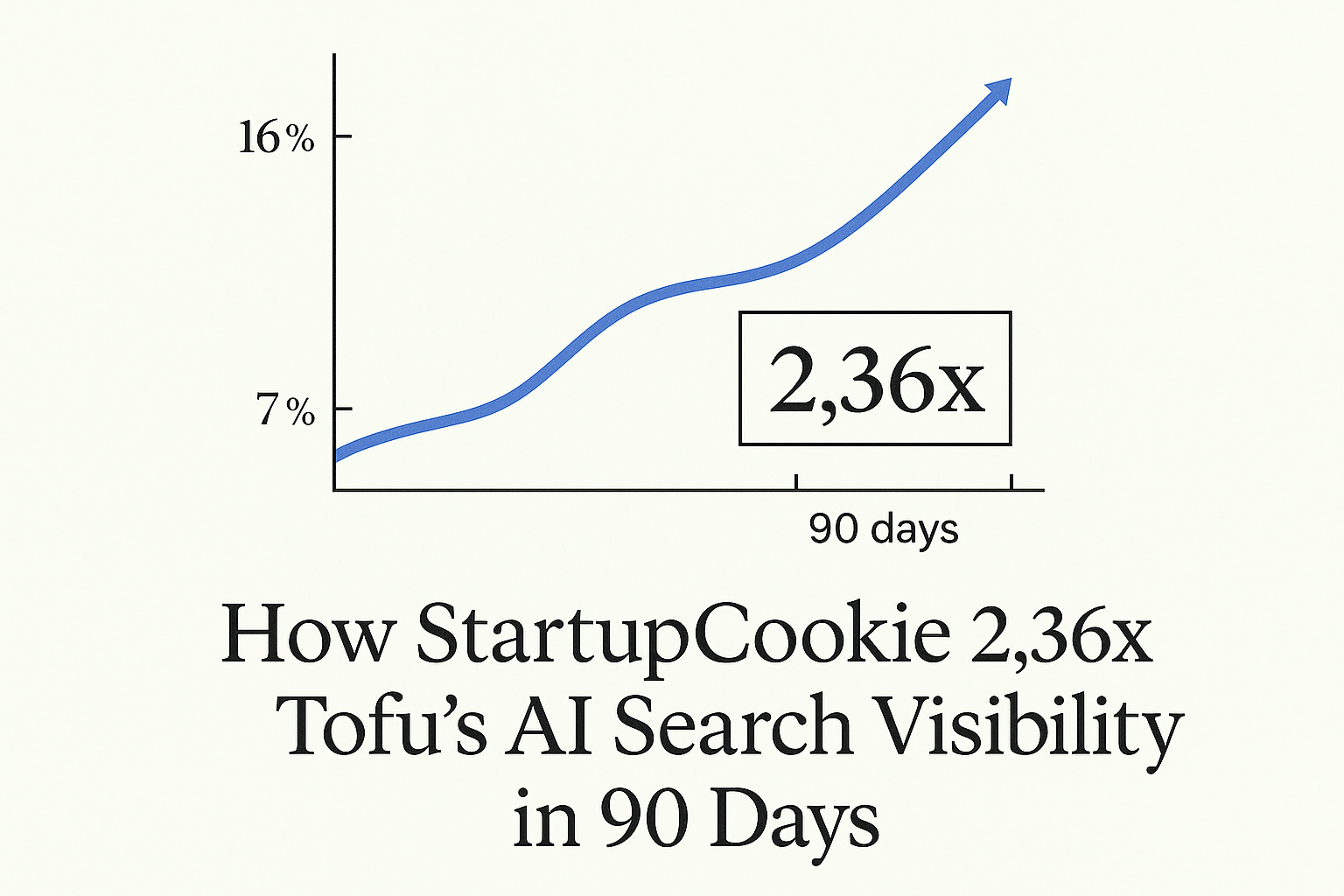
StartupCookie took Tofu's AI search visibility from 7.00% to 16.51% in 90 days, a 2.36x lift. By May 14, 2026, tofuhq.com was the #2 most-cited domain in the entire Profound Marketing Technology category, ahead of HubSpot, YouTube, and Reddit, behind only LinkedIn. On Google AI Overviews specifically, Tofu reached 26.50% visibility, meaning Tofu appears in roughly 1 in 4 AI-generated answers for Marketing Technology buyer queries. Every number in this case study is pulled from Tofu's Profound dashboard via the Profound REST API on May 15, 2026. The full set of changes that produced these results was implemented by StartupCookie over a 90-day engagement and is documented below.
The 90-day visibility trajectory: 7.00% to 16.51%
Tofu's Visibility Score in Profound's Marketing Technology category climbed from 7.00% on Feb 14 to 16.51% on May 14. That is a 2.36x increase in 90 days, or +9.51 percentage points. The most recent 30-day window (April 15 to May 14) averaged 13.95%, an 85% lift over the prior 30 days (7.52%). The trajectory is still rising as of publication; the May 14 number is not the peak.
Source: Profound, Visibility Score for asset_name=Tofu, daily series, Feb 14 to May 14, 2026.
Where Tofu now ranks in the Marketing Technology category
#2 most-cited domain, ahead of HubSpot, YouTube, and Reddit
Across the entire Marketing Technology category on Profound, tofuhq.com is the #2 most-cited domain, with 2.88% citation share and 5,421 citations in the last 30 days. The only domain cited more is LinkedIn at 2.98%. Tofu's owned domain is cited more than HubSpot (1.87%), Reddit (2.22%), and YouTube (2.46%) for B2B buyer questions in this category.
To put this in context: HubSpot is a $30B+ public company with thousands of employees and tens of thousands of inbound backlinks. Tofu is a seed-stage startup that has been building for fewer than two years. Tofu closed that gap on AEO discipline and structured-data depth, without HubSpot's budget or backlink profile.
Strongest engine: Google AI Overviews at 26.50% visibility
Google AI Overviews is the AI engine most directly tied to B2B buyer behavior right now. AI Overviews appear above the organic search results for roughly 44% of queries per BrightEdge's 2025 SERP research. Tofu's 26.50% AIO visibility means Tofu shows up in roughly 1 in 4 AI-generated answers for Marketing Technology buyer queries. That is competitive with brands 5 to 10 times Tofu's size on funding and employee count. The dividend is direct: when a marketing leader Googles "best AI marketing platform" or "Mutiny alternatives," Tofu is in the answer Google generates above the blue links.
Leaderboard position: #9 of 15+, ahead of 6 named competitors
Tofu now sits at #9 of 15+ tracked brands in the Profound Marketing Technology category. Tofu is ahead of Mutiny, Marketo, Clay, Apollo, Zapier, and Outreach on Visibility Score. Most of those competitors have 10x more funding and 5x more employees than Tofu. On visibility per dollar of funding, Tofu likely outperforms every brand on this list.
The Feb 2026 baseline: where Tofu started
Tofu's AI search posture in mid-February was weak relative to its product positioning. The brand had a serious presence with B2B marketing teams but AI engines were not citing Tofu at meaningful rates when buyers asked questions like "best AI marketing platform" or "Tofu vs Mutiny." The specific gaps on Feb 14:
- Tofu Visibility Score: 7.00%, fluctuating 7 to 10 percent through late February.
- No Organization or WebSite JSON-LD schema anywhere on tofuhq.com.
- No Wikidata Q-item. No Google Knowledge Panel.
- Mobile LCP: 10.08 seconds (Google's target is 2.5s or below).
- 11 core pages with missing meta descriptions and thin title tags.
- Zero glossary content with DefinedTerm schema. Zero comparison content with FAQPage and SoftwareApplication schema.
- 7 stale URLs returning 404 after a homepage redesign.
What StartupCookie shipped over 90 days
Three workstreams. The structured-data and page-architecture work drove the measured 90-day growth. Entity grounding is the compounding bet: the Wikidata Q-item shipped May 13, one day before the measurement window closed, so its payoff lands in the next 90 days.
Entity grounding (the compounding bet)
- Submitted and published Wikidata Q-item Q139784599 with 9 sourced statements (inception, headquarters, founders, official website, country, industry, Twitter, LinkedIn, Crunchbase).
- Site-wide Organization JSON-LD with a sameAs trust chain linking LinkedIn, Twitter, Crunchbase, and the new Wikidata Q-id. This is the pipeline Google follows to auto-generate a Knowledge Panel.
- Site-wide WebSite JSON-LD.
Structured data depth
- 20 glossary pages live at /glossary/{slug} with DefinedTerm + BreadcrumbList JSON-LD covering agentic demand generation, 1:1 ABM, AI SDR, brand knowledge graph, intent signals, generative marketing, lifecycle marketing, ICP, MQL-to-SQL conversion, pipeline acceleration, and ten others.
- 9 comparison blog posts patched via the Webflow CMS API with FAQPage and SoftwareApplication JSON-LD: Tofu vs Mutiny, Jasper, Copy.ai, ChatGPT, UserLed, Writer, Warmly, 6sense, Demandbase.
- JS-injected BreadcrumbList schema site-wide for Google indexing.
Page-level optimization
- SEO titles and meta descriptions rewritten on 11 pages, all in the 50-60 character title and 140-160 character meta spec.
- 7 301 redirects added to preserve SEO equity from URLs that 404'd after Tofu's redesign.
- defer attributes applied to render-blocking scripts. Mobile LCP improved 10.08s to 8.7s.
Why this worked: entity grounding compounds, content alone does not
Three observations from the data.
Structured data and page architecture drove the measured growth. The glossary pages, comparison posts, and page-level fixes were live for most of the 90-day window and gave AI engines machine-readable surfaces to cite. Entity grounding is the bet that compounds next: the Wikidata Q-item shipped May 13, one day before measurement ended, and the Q-item plus the Organization sameAs trust chain is what Google Knowledge Graph follows to build a Knowledge Panel. Once that pipeline is in motion, every AI engine that grounds against Google KG gets better branded answers. Most B2B SaaS programs skip this because it feels too foundational. It is the foundation.
Structured data depth scales. 20 glossary pages with DefinedTerm schema, 9 comparison posts with FAQPage and SoftwareApplication schema, and site-wide BreadcrumbList do not sound like a lot until you realize each is a citable surface. Profound's daily citation count for this category climbed from roughly 2,100 per day in mid-February to roughly 6,870 per day in mid-May. The category-wide citation pool more than tripled, and Tofu's share of it grew at the same time.
The Google AI Overviews dividend is the prize. AIO is the engine most directly tied to buyer behavior right now. Tofu's AIO visibility (26.50%) runs nearly 10 percentage points ahead of its overall Visibility Score (16.51%), which suggests Google's answer engine responds fastest to this kind of schema work. Compete on AIO and you compete with companies 5 to 10x your size.
What is compounding next
The 90-day trajectory is still climbing. Realistic next 90 days, all else equal:
- Google Knowledge Panel typically appears 4 to 12 weeks after the Wikidata sameAs link is published. Tofu shipped May 13. Expected: late June to early August 2026.
- Visibility Score trajectory targets 20 to 25 percent by mid-August at the current growth rate, which would pull Tofu ahead of ZoomInfo and into the top 8 of the category.
- Citation share compounds as schema and entity grounding mature. The current 2.88% owned-domain share is the highest in Tofu's 90-day history.
Frequently asked questions
What does "AI search visibility" actually measure?
Profound's Visibility Score is the share of AI-generated answers (across ChatGPT, Claude, Perplexity, Google AI Overviews, Gemini, and others) where a brand appears, measured across a defined prompt set for a category. A 16.51% score means the brand shows up in roughly 1 in 6 answers for that category's buyer queries. The metric is closer to "share of voice in AI answers" than to "rank on Google."
Why is Google AI Overviews specifically singled out?
AIO appears above the organic ten-blue-links results for roughly 44% of queries (BrightEdge, 2025). For B2B buyers, the AI Overview answer is now the first thing they read, often before they click any link. Winning AIO citation is now closer in importance to winning the #1 organic position than it is to a secondary metric.
Did Tofu have to rebuild its site to get these results?
No. Tofu's site is on Webflow. StartupCookie patched 9 comparison posts via the Webflow CMS API, added schema via JS injection in the global site code, and shipped 20 new glossary pages as standard Webflow pages. No rebuild, no platform migration.
How long does entity grounding (Wikidata + Knowledge Panel) take?
Wikidata Q-item publication takes 1-3 weeks (most of that is community review). Google Knowledge Panel appears 4-12 weeks after the sameAs link is live. Tofu shipped the Q-item on May 13, so the Knowledge Panel is expected late June to early August 2026.
Is this replicable for other B2B SaaS startups?
Yes, and StartupCookie has run versions of this playbook for several B2B SaaS clients. The entity-grounding piece is essentially mechanical for any company that meets Wikidata's notability bar (most funded B2B SaaS companies do). The structured-data depth piece is templated production work. The 2.36x lift number is specific to Tofu's baseline; other clients see different starting points and different ceilings.
What did StartupCookie not do?
StartupCookie did not run Tofu's content team, did not write Tofu's product positioning, and did not handle Tofu's paid ads. The engagement was scoped specifically to AEO and entity grounding, with Tofu's team handling the rest. AEO is the layer that makes the rest of the marketing function visible to AI engines; it is not a replacement for the marketing function.
What tools did StartupCookie use?
Profound for citation tracking and Visibility Score measurement. Wikidata for entity grounding. Schema.org JSON-LD validators for structured data. The Webflow CMS API for content patches. Standard Lighthouse and PageSpeed Insights for the Core Web Vitals work. No proprietary tools; everything is the playbook in our AEO for B2B SaaS guide, executed with discipline.
How much did the engagement cost?
Scope and pricing are custom. AEO-only engagements at the scope of this one (entity grounding + 20+ schema-rich pages + Core Web Vitals work + comparison content patches) run either as a 90-day fixed-scope sprint or as a monthly retainer for ongoing AEO work. Current rates are on the Pricing section of our homepage; book a call for a quote scoped to your site.